
Samburu National Reserve is a 165 km² county-managed protected area on the northern bank of the Ewaso Nyiro River in northern Kenya. It is best known for the Samburu Special Five, elephants, big cats, dry-country birdlife and the contrast between arid plains and riverine woodland. Most visitors should allow two or three nights, enter through the gate serving their accommodation and use a 4×4 with a qualified guide.
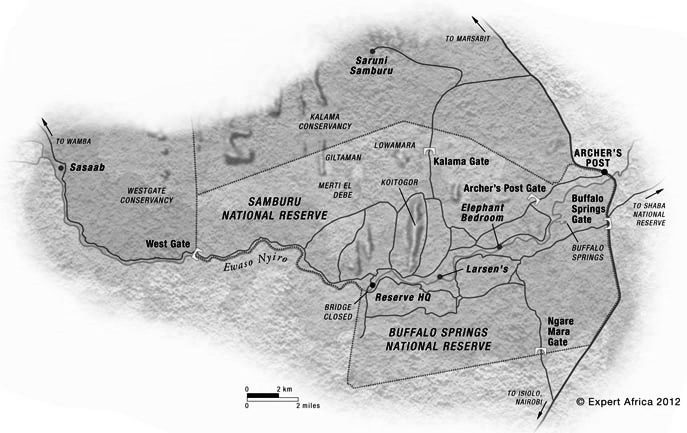
The most suitable Samburu safari depends on the traveller’s priority. Wildlife-focused visitors need enough game-drive windows to search different habitats. Photographers benefit from a private vehicle and three or more nights. Families should reduce transfer fatigue and choose a property with flexible meals and drives. Travellers adding conservancy activities must distinguish what is permitted inside the national reserve from what is offered on adjacent community land.
Samburu National Reserve is not the same entity as Samburu County, the wider Samburu ecosystem, Buffalo Springs National Reserve, Shaba National Reserve or nearby community conservancies. Those places connect ecologically and through safari itineraries, but they have different boundaries, administrations, fees, gates, rules and accommodation relationships.
SamburuReserve.org is an independent destination guide dedicated to Samburu National Reserve and its connected northern Kenya safari landscape. Our guidance combines detailed destination research with insight from trained local Samburu wildlife guides who understand how the area’s reserves, river systems, habitats, wildlife, safaris, conservancies and communities fit together.
We apply that knowledge to practical visitor decisions. A lodge name may say “Samburu” while the property is in Buffalo Springs or a conservancy. A road that looks short on a map may approach the wrong gate. A wildlife list may imply equal probability even though water, vegetation, heat and animal movement control sightings. Connecting each entity to its actual location and function produces more reliable guidance.
Samburu National Reserve at a glance
| Visitor question | Direct answer |
|---|---|
| What is Samburu National Reserve? | A county-managed wildlife reserve in Samburu County, northern Kenya |
| How large is it? | Approximately 165 km² |
| Which river shapes the reserve? | The Ewaso Nyiro River |
| What is it famous for? | The Samburu Special Five, elephants, dryland wildlife, birds and dramatic riverine scenery |
| Which animals form the Special Five? | Grevy’s zebra, reticulated giraffe, gerenuk, Beisa oryx and Somali ostrich |
| How many nights are suitable? | Two nights for an introduction; three nights for a balanced safari |
| Main road entrance | Archer’s Gate near Archer’s Post |
| Other access relationships | West Gate, the river-crossing side, conservancy approaches and airstrip transfers |
| Best general vehicle | High-clearance 4×4 safari vehicle |
| Can wildlife be guaranteed? | No. Sightings depend on habitat, season, guide skill and animal movement |
| Is it open year-round? | Generally yes, but roads, weather and accommodation operations vary |
| Who administers it? | Samburu County Government rather than KWS as a national park |
| Are Buffalo Springs and Shaba included? | No. They are separate reserves with their own access and charges |
| Can visitors walk freely? | No. Walking is restricted and normally conducted in authorised conservancy or operator settings |
| Best next planning step | Match season, transport and accommodation before paying |
What is Samburu National Reserve?
Samburu National Reserve is a protected wildlife area within Samburu County in northern Kenya. Its southern boundary and ecological identity are strongly associated with the Ewaso Nyiro River. Buffalo Springs National Reserve lies mainly across the river in Isiolo County, while Shaba National Reserve forms a separate protected landscape farther east.
The reserve protects part of a wider ecosystem rather than an isolated wildlife island. Elephants, carnivores, Grevy’s zebra, reticulated giraffes and other animals move across:
- Samburu National Reserve;
- Buffalo Springs;
- Shaba;
- community conservancies;
- pastoral rangelands;
- river corridors; and
- other parts of northern Kenya.
The reserve boundary controls visitor entry and management. It does not contain the entire ecological range of the animals seen during a game drive.
Why the word “reserve” matters
Samburu is a national reserve rather than a Kenya Wildlife Service national park. In Kenya, national reserves are commonly administered by county governments, while national parks fall under national KWS management.
For the traveller, that distinction affects:
- entry fees;
- payment procedures;
- management contacts;
- gate systems;
- rule verification;
- vehicle charges; and
- how neighbouring protected areas are ticketed.
Do not assume that a KWS park ticket, account or tariff automatically applies to Samburu National Reserve.
Where is Samburu National Reserve?
Samburu National Reserve lies in Samburu County north of the Ewaso Nyiro River, reached from Nairobi through the central highlands, Nanyuki, Isiolo and Archer’s Post.
Its geographic relationships are:
- Nairobi lies to the south and serves as the main international arrival and safari departure point.
- Nanyuki lies along the main northern road corridor and can serve as a Laikipia or Mount Kenya stop.
- Isiolo is the principal road gateway before the final approach towards Archer’s Post.
- Archer’s Post lies near the main reserve approach.
- Buffalo Springs National Reserve lies across the Ewaso Nyiro in Isiolo County.
- Shaba National Reserve lies farther east within the wider three-reserve safari landscape.
- Kalama and Westgate connect the reserve to community-conservancy stays.
- Namunyak and the Mathews Range lie farther north and require a deliberate extension.
The detailed guide to where Samburu National Reserve is located owns coordinates, county relationships, road distances and map orientation.
Check out Google Streetview of Samburu National Reserve on this Google 2015 Project.
The Ewaso Nyiro River
The Ewaso Nyiro is Samburu National Reserve’s controlling ecological feature because it supplies water and supports riverine vegetation within an otherwise dry landscape.
The river influences:
- where elephants drink and cross;
- where hippos and crocodiles occur;
- where doum palms and riverine woodland grow;
- where predators may use shade and cover;
- where herbivores concentrate during dry conditions;
- how camps and lodges are positioned;
- which roads are productive; and
- how drought affects the wider ecosystem.
The river’s flow is variable. Rainfall in distant highlands, upstream abstraction, drought and local weather affect water availability. A calendar month alone cannot guarantee the depth or continuity of visible flow.
Practical consequence for game drives
During dry conditions, the river corridor often becomes increasingly important. Guides may begin around open areas while temperatures are lower, check river access as animals seek water, then use shade, tracks and recent reports to refine the route.
After rain, surface water and fresh forage can disperse wildlife away from the most obvious river sections. The reserve may look greener, but the search can require broader habitat coverage.
The Ewaso Nyiro River ecosystem guide explains water flow, riverine habitat, wildlife dependency and conservation pressure in greater depth.
Samburu habitats and landscapes
Samburu is not one uniform savannah. Its wildlife distribution is controlled by several connected habitats.
Riverine woodland
Riverine vegetation along the Ewaso Nyiro provides:
- shade;
- browse;
- water access;
- cover for leopards and smaller animals;
- nesting and feeding habitat for birds;
- hippo and crocodile habitat; and
- movement routes for elephants.
Dense cover can make animals harder to see even when signs are fresh.
Acacia–commiphora bushland
Dry bush and thorn scrub support:
- gerenuk;
- dik-diks;
- reticulated giraffes;
- elephants;
- browsing antelopes;
- birds;
- leopards; and
- many reptiles and smaller mammals.
The habitat rewards slow driving and attention to movement between bushes.
Open plains
Open areas improve long-distance scanning for:
- Grevy’s and plains zebras;
- Beisa oryx;
- Somali ostriches;
- elephants;
- cheetahs;
- jackals;
- vultures; and
- other grassland or open-country species.
Visibility does not guarantee presence. Heat haze can also reduce useful viewing and photography.
Dry riverbeds and drainage lines
Seasonal channels create:
- shaded edges;
- animal paths;
- exposed sand that records tracks;
- den sites and cover;
- temporary water after rain; and
- natural corridors through the bush.
Guides use tracks, calls and recent movement to decide whether a drainage line deserves patient searching.
Rocky hills and outcrops
Elevated and rocky areas add:
- landscape viewpoints;
- habitat for hyraxes, reptiles and birds;
- raptor perches;
- potential leopard terrain;
- geological contrast; and
- a wider sense of the northern landscape.
The Samburu habitats and landscapes guide owns the complete habitat-to-species model.
Wildlife in Samburu National Reserve
Samburu supports a combination of northern specialist species and animals familiar from other East African safaris.
Visitors may look for:
- Grevy’s zebra;
- reticulated giraffe;
- gerenuk;
- Beisa oryx;
- Somali ostrich;
- elephants;
- lions;
- leopards;
- cheetahs;
- spotted hyenas;
- African wild dogs when present in the wider landscape;
- buffalo;
- plains zebra;
- impala;
- Grant’s gazelle;
- Kirk’s dik-dik;
- waterbuck;
- warthogs;
- olive baboons;
- vervet monkeys;
- hippos;
- Nile crocodiles;
- raptors;
- dry-country birds; and
- reptiles and smaller wildlife.
The wildlife of Samburu National Reserve hub organises this diversity into species groups and identification guides. This reserve guide explains wildlife only as part of the overall visitor decision.
The Samburu Special Five
The Samburu Special Five are five northern Kenya species that collectively distinguish the destination:
- Grevy’s zebra;
- reticulated giraffe;
- gerenuk;
- Beisa oryx; and
- Somali ostrich.
They are not endemic to Samburu National Reserve and do not live as one group. Each uses habitat differently.
| Species | Identification clue | Habitat relationship |
| Grevy’s zebra | Narrow stripes, white belly and large ears | Open dry country with access to water |
| Reticulated giraffe | Large polygonal brown patches separated by pale lines | Browse-rich bushland and woodland |
| Gerenuk | Long neck and upright browsing behaviour | Thorn scrub and dry bush |
| Beisa oryx | Long straight horns and bold facial markings | Open arid plains and scrub |
| Somali ostrich | Adult male with blue-grey neck and legs | Open bushland and plains |
Allow several game drives rather than expecting a single “Special Five loop.” The detailed Samburu Special Five guide owns identification, ecology and species-level conservation.
Elephants
Samburu is one of Kenya’s most important destinations for observing elephants within a dryland river system.
Elephants use the Ewaso Nyiro for:
- drinking;
- bathing;
- crossing;
- feeding;
- resting in shade; and
- movement between protected and community lands.
Research organisations have followed identified elephants and families across the ecosystem for decades. That knowledge allows informed guides to explain family relationships, age, movement and behaviour rather than describing every encounter generically.
No one can guarantee:
- a river crossing;
- a named elephant;
- a close approach;
- a particular family;
- a baby elephant; or
- a conflict-free sighting.
The Samburu elephant guide covers family structure, research, corridors, water and responsible viewing.
Lions, leopards and cheetahs
Samburu supports all three major African big cats, but each requires a different search strategy.
Lions
Lions may use:
- open plains;
- shade near riverine habitat;
- dry riverbeds;
- bush edges;
- rocky areas; and
- zones with prey concentrations.
Leopards
Leopards favour cover and are often difficult to locate. Guides check:
- riverine trees;
- drainage lines;
- rocky habitat;
- alarm calls;
- tracks; and
- recent local reports.
Cheetahs
Cheetahs need visibility and space. Open plains and lightly bushed areas provide the most logical search habitat, but individual movements extend beyond fixed visitor routes.
Use the big cats of Samburu guide for species-specific behaviour and viewing ethics.
Birds
Samburu is a strong birding destination because dry-country, riverine, open-plains and rocky habitats occur close together.
Birding interests include:
- Somali–Masai biome species;
- raptors;
- vultures;
- kingfishers and river birds;
- bustards;
- hornbills;
- rollers;
- bee-eaters;
- coursers;
- sandgrouse;
- parrots;
- starlings;
- weavers; and
- seasonal migrants.
Birders should request:
- a guide with northern Kenya identification experience;
- a private vehicle;
- a slower schedule;
- binocular-friendly seating;
- early starts;
- time outside mammal-sighting crowds; and
- a checklist using current taxonomy.
The birds of Samburu guide owns habitat, season and notable-species depth.
Best time to visit Samburu
Samburu is a year-round destination, but the best time depends on whether the visitor prioritises concentrated wildlife, green scenery, birding, road reliability, lower prices or fewer vehicles.
Drier periods
Typical advantages:
- wildlife becomes more dependent on lasting water;
- vegetation may thin;
- roads are usually more predictable;
- dust can create dramatic light; and
- river relationships become visually clear.
Typical disadvantages:
- heat;
- dust;
- reduced greenery;
- popular-season accommodation demand; and
- pressure on wildlife and water.
Wetter and greener periods
Typical advantages:
- fresh browse and grass;
- dramatic skies;
- bird activity;
- young animals;
- colourful landscapes; and
- possible lower-season value.
Typical disadvantages:
- muddy or damaged tracks;
- dispersed wildlife;
- denser vegetation;
- insects;
- flash flooding or difficult drainage crossings; and
- unpredictable transfer times.
Rain in northern Kenya does not always follow a perfectly reliable calendar. The best time to visit Samburu guide owns the month-by-month comparison.
How many days do you need?
One day
A single day is only an introduction and is rarely sensible from Nairobi by road. It can work for travellers already staying in the ecosystem.
Two nights
Two nights generally provide:
- an arrival afternoon;
- one full day;
- one departure morning; and
- limited margin for delays or elusive species.
Three nights
Three nights provide:
- two full safari days;
- several morning and afternoon drives;
- better habitat coverage;
- more time for elephants, big cats and the Special Five; and
- protection against one quiet drive.
Four or more nights
Longer stays suit:
- photography;
- birding;
- slow travel;
- conservancy activities;
- community-led experiences;
- families needing shorter drives; and
- specialist wildlife interests.
The how many days to spend in Samburu guide calculates usable safari windows rather than counting room nights alone.
How to get to Samburu
Visitors reach Samburu by road, scheduled light aircraft or private charter.
Road from Nairobi
The principal road sequence is:
Nairobi → Thika/central highlands → Nanyuki → Isiolo → Archer’s Post → selected gate → accommodation
A realistic journey depends on:
- Nairobi departure point;
- traffic;
- meal and equator stops;
- roadworks;
- weather;
- gate;
- lodge; and
- the final unsealed section.
Treat five- or six-hour claims as idealised driving estimates rather than door-to-door guarantees. A full travel day is safer for planning.
Flying from Wilson Airport
Scheduled safari airlines serve airstrips within the Samburu ecosystem. A fly-in trip still requires:
- Wilson Airport check-in;
- baggage compliance;
- possible intermediate stops;
- a confirmed airstrip;
- lodge collection;
- ground transfer; and
- coordination of the first game drive.
Flight schedules and stop patterns change. The Samburu fly-in safari guide owns the complete flight decision.
Private charter
Charters may suit:
- groups;
- private families;
- complex circuits;
- special baggage;
- Reteti or remote-conservancy extensions; and
- travellers connecting from another safari area.
Aircraft availability, runway suitability, passenger weights and positioning control the price.
The main getting to Samburu guide compares the full origin-to-property chain for road and air.
Samburu National Reserve gates
Choose the gate serving the actual accommodation and route rather than selecting the best-known gate by default.
Archer’s Gate
Archer’s Gate near Archer’s Post is the main road entrance for many visitors arriving from Nairobi and Isiolo.
It commonly suits:
- road arrivals;
- camps in the eastern and central reserve;
- operators using the Great North Road corridor; and
- first-time visitors needing the clearest approach.
West Gate relationship
West Gate connects the reserve’s western side with Westgate Community Conservancy and properties using that landscape. Access arrangements can be accommodation-specific.
River-crossing or southern access
Visitors approaching from Buffalo Springs may use the bridge or relevant crossing arrangements. Buffalo Springs and Samburu remain separate reserves. Confirm:
- whether the crossing is open;
- which ticket is required;
- operating hours;
- road condition; and
- whether the itinerary incurs separate entry charges.
Kalama and conservancy approaches
Kalama Conservancy lies north of the reserve. A Kalama property may provide access to the reserve through an agreed route, but Kalama is not a Samburu National Reserve gate in the same administrative sense as a reserve entrance.
Airstrip access
Fly-in visitors are met at the airstrip serving the property. The closest-looking airstrip may not be the one used by the booked airline or lodge.
Gate names and procedures are volatile. The Samburu entrance-gates guide should be checked immediately before self-drive or transfer planning.
Samburu entry fees
Samburu National Reserve charges depend on:
- citizenship or residency category;
- adult, child or eligible student status;
- vehicle class;
- camping;
- aircraft landing;
- activities; and
- the applicable tariff date.
Do not confuse:
- reserve entry with a safari-package price;
- Samburu fees with Buffalo Springs or Shaba fees;
- per-person fees with vehicle charges;
- a calendar day with the authority’s validity period; or
- an operator’s included fee with direct gate payment.
The current Samburu National Reserve fees guide owns rates, effective dates, payment instructions and eligibility documents. Confirm the tariff again before payment.
Rules and responsible wildlife viewing
Visitors should expect rules covering:
- gate hours;
- speed;
- remaining on designated roads;
- off-road restrictions;
- wildlife distance;
- noise;
- feeding animals;
- litter;
- drones;
- alcohol and driving;
- fires;
- leaving vehicles; and
- prohibited night driving within the reserve.
Responsible viewing means:
- wildlife always has right of way;
- no vehicle should block an animal’s route;
- elephants need additional space when calves are present;
- predators should not be surrounded;
- guides should avoid cutting off moving animals;
- engine noise should be reduced during quiet behaviour;
- sightings should not be geotagged when location sensitivity matters; and
- visitor pressure should never override animal welfare.
Review the Samburu reserve rules and safari etiquette before entry.
Things to do in Samburu
Game drives are the primary activity inside Samburu National Reserve. The wider ecosystem adds activities that may not be permitted inside the reserve.
Game drives
Game drives can be:
- early morning;
- late afternoon;
- full day;
- private;
- shared;
- wildlife-focused;
- photographic; or
- birding-oriented.
The best route depends on habitat, weather, recent animal movement, road condition and guest priorities. The Samburu game-drive guide owns schedule, vehicle, guide and route-selection detail.
Photography
Photography benefits from:
- private vehicle use;
- one photographer per row where practical;
- beanbags;
- extra batteries;
- dust protection;
- clear guide communication;
- patience; and
- ethical positioning.
Birdwatching
Birding requires slower drives and frequent stops. A standard large-mammal game drive is not automatically a birding safari.
Walking
Unrestricted walking is not a normal activity inside the wildlife reserve. Guided walks are more commonly offered through authorised conservancy or lodge settings with appropriate safety measures.
Night drives
Night drives are generally associated with conservancies rather than unrestricted operation inside the national reserve. Confirm the land unit and permission.
Cultural and community experiences
Choose experiences that:
- are community-led;
- provide transparent payment;
- use qualified local interpreters;
- obtain consent for photography;
- avoid intrusive or staged interactions; and
- allow hosts to control what is shared.
Conservation visits
Depending on access and advance arrangements, visitors may learn from organisations involved in:
- elephant research;
- lion coexistence;
- Grevy’s zebra conservation;
- community conservancies;
- wildlife rescue; and
- habitat protection.
The things to do in Samburu guide compares activities and identifies where they are legally and practically available.
Where to stay
Accommodation described as “Samburu” can be:
- inside Samburu National Reserve;
- inside Buffalo Springs;
- near Shaba;
- in Kalama Conservancy;
- in Westgate Conservancy;
- near Archer’s Post;
- beside the Ewaso Nyiro; or
- elsewhere in the wider region.
Location controls:
- gate choice;
- daily transfer time;
- reserve fees;
- wildlife habitat;
- available activities;
- airstrip pickup;
- whether night drives or walks are possible; and
- whether a visitor enters the national reserve every day.
Inside or associated with Samburu National Reserve
Elephant Bedroom Camp
- Setting: Tented accommodation beside the Ewaso Nyiro.
- Best for: River atmosphere, elephants and an intimate tented stay.
- Decision point: Confirm current operating status, exact access and whether drives are private or shared.
Elephant Watch Camp
- Setting: Small camp with a strong relationship to elephant research and river habitat.
- Best for: Travellers prioritising elephants, interpretation and specialist guiding.
- Decision point: Compare inclusions, seasonal operation and vehicle arrangements.
Samburu Intrepids
- Setting: Established tented camp within the reserve landscape.
- Best for: Families and visitors wanting a conventional full-service safari camp.
- Decision point: Confirm family rooms, child programmes, game-drive structure and airstrip transfers.
Samburu Game Lodge
- Setting: Lodge beside the Ewaso Nyiro.
- Best for: Travellers wanting substantial facilities and a long-established reserve property.
- Decision point: Check room category, renovation status, meal plan and actual game package.
Samburu Sopa Lodge
- Setting: Elevated and more removed from the main river corridor.
- Best for: Views, lodge facilities and groups.
- Decision point: The hill location can add travel time to some river-focused game-drive areas.
Larsen’s Camp
- Setting: River-oriented tented camp associated with a more intimate style.
- Best for: Couples and premium tented-camp travellers.
- Decision point: Verify current opening, management and inclusions before presenting it as available.
Buffalo Springs properties
Properties across the river may use “Samburu” in their name or destination description while being located in Buffalo Springs National Reserve.
This is not necessarily a disadvantage. Buffalo Springs can provide:
- different road networks;
- open plains;
- spring and river access;
- alternative airstrip relationships; and
- complementary game drives.
However, the traveller must understand which reserve’s fees and rules apply.
Community-conservancy properties
Sasaab
- Landscape: Westgate Community Conservancy across the wider river area.
- Best for: Premium stays, cultural context, walking or other conservancy activities.
- Decision point: Confirm reserve-transfer time and whether Samburu game drives are included.
Saruni Samburu
- Landscape: Kalama Conservancy north of Samburu National Reserve.
- Best for: Elevated views, conservancy activities and premium lodging.
- Decision point: Daily reserve access requires deliberate routing; do not describe the lodge as inside Samburu National Reserve.
The complete where to stay in Samburu guide compares more named properties by gate, habitat, airstrip, price logic and traveller type.
Which accommodation area is best?
Choose:
- inside the reserve for early access to reserve game-drive roads;
- Buffalo Springs for a complementary southern-bank landscape;
- Kalama for conservancy activities and a northern elevated setting;
- Westgate for community-conservancy context and selected exclusive properties;
- Shaba only when Shaba itself is a destination objective; or
- Archer’s Post/outside for budget or road-access reasons, accepting gate travel.
Samburu, Buffalo Springs and Shaba
These three protected areas are related but not interchangeable.
| Protected area | Identity | Main relationship to Samburu |
| Samburu National Reserve | County-managed reserve north of the Ewaso Nyiro | Central subject of this guide |
| Buffalo Springs National Reserve | Separate reserve mainly south of the river in Isiolo County | Complementary habitats and road network |
| Shaba National Reserve | Separate reserve farther east | Volcanic scenery, riverine oases and conservation history |
The Samburu, Buffalo Springs and Shaba comparison helps visitors choose one reserve or build a combined stay without blurring their identities.
Samburu and community conservancies
Community conservancies connect wildlife conservation with:
- locally governed land;
- livestock;
- grazing;
- tourism revenue;
- ranger employment;
- wildlife corridors;
- community services; and
- cultural continuity.
They can permit activities unavailable in the national reserve, but availability depends on the specific conservancy and property.
The Samburu community conservancies guide explains the governance model and compares Kalama, Westgate, Namunyak, Sera and other landscapes.
Safari vehicles and guides
The standard vehicle choices are:
- extended 4×4 Land Cruiser with pop-up roof;
- open-sided lodge vehicle;
- enclosed 4×4;
- safari van on suitable roads; and
- self-drive 4×4.
A Land Cruiser is generally the most adaptable choice because it combines:
- high clearance;
- rough-road capability;
- raised viewing;
- roof access;
- luggage capacity; and
- recovery potential.
Open-sided vehicles provide excellent viewing but may be tied to a lodge and may be less suitable for long highway transfers.
What a qualified guide adds
A skilled local guide connects:
- track and sign;
- alarm calls;
- water;
- shade;
- prey movement;
- animal behaviour;
- local names;
- conservation;
- community land;
- seasonal roads; and
- ethical positioning.
SamburuReserve.org seeks to increase the visibility of qualified local Samburu guides because local knowledge changes the quality of interpretation and helps retain tourism value locally.
Families
Samburu can work well for families when the trip reduces heat, road fatigue and rigid schedules.
Choose:
- three nights rather than two;
- private vehicle use;
- family tent or connecting rooms;
- flexible meals;
- shorter drives for younger children;
- swimming-pool access where appropriate;
- a property with clear fencing and escort rules;
- reliable drinking water;
- car seats or working seat belts; and
- a realistic transfer plan.
Ask about minimum ages for walks, camel activities, conservation visits and shared drives.
Accessibility
Accessibility varies substantially.
Ask for:
- step-free route from room to dining;
- path surface;
- room-door width;
- bathroom measurements;
- grab rails;
- shower threshold;
- bed height;
- vehicle boarding height;
- portable step;
- wheelchair storage;
- emergency evacuation; and
- actual photos of the assigned room.
A lodge describing itself as accessible is not enough. Verify the exact room and vehicle.
Health and safety
Travellers should obtain individual medical advice before travel.
General preparation may include:
- travel insurance;
- medical evacuation cover;
- prescribed medication;
- malaria-risk discussion;
- insect repellent;
- sunscreen;
- hydration;
- heat management;
- food and water precautions;
- first-aid supplies; and
- emergency contacts.
Inside the reserve:
- remain in the vehicle except at authorised points;
- follow guide and ranger instructions;
- never approach wildlife on foot;
- avoid night road travel where possible;
- do not leave food accessible;
- use lodge escorts after dark; and
- keep children supervised.
The Samburu safari safety guide owns the complete risk-preparation framework.
What to pack
Pack:
- neutral lightweight clothing;
- warm layer for early drives;
- sun hat;
- sunglasses;
- sunscreen;
- insect repellent;
- comfortable closed shoes;
- reusable water bottle;
- binoculars;
- camera;
- dust protection;
- power bank;
- travel adapter;
- prescription medication;
- soft-sided luggage for light aircraft;
- copies of identification; and
- offline confirmations.
Avoid camouflage-pattern clothing where it could be confused with military use. Check airline baggage rules before packing hard cases.
The Samburu packing list provides a season- and transport-specific checklist.
How much does a Samburu safari cost?
The total cost is controlled by:
- road or air transport;
- accommodation;
- season;
- group size;
- private or shared vehicle;
- reserve fees;
- conservancy charges;
- number of nights;
- meal plan;
- optional activities;
- child policy;
- single supplement;
- guide or driver accommodation; and
- taxes.
A lower room rate can create a higher total if it excludes drives, transfers and fees. A premium game package may look expensive while including most operating components.
The Samburu safari cost guide owns budget ranges and quotation comparison. The Samburu safari packages hub helps visitors compare road, fly-in, family, private and multi-destination formats without turning this reserve guide into a package catalogue.
Responsible cultural experiences
A respectful Samburu cultural experience should:
- be hosted with community consent;
- state the visit price;
- explain how payment is distributed;
- use a local interpreter;
- ask before photographing people;
- avoid treating homes as displays;
- allow hosts to decline questions;
- avoid gifts that encourage begging;
- buy crafts directly where appropriate; and
- represent Samburu culture as contemporary and living.
Culture should not be presented as a decorative add-on to wildlife. Samburu communities shape land use, guiding, conservation, livestock systems and the visitor’s understanding of the landscape.
Conservation context
Samburu’s wildlife depends on more than the reserve boundary.
Major conservation relationships include:
- elephant research and corridor protection;
- Grevy’s zebra monitoring;
- lion coexistence;
- community conservancies;
- river-water pressure;
- livestock and grazing management;
- road and infrastructure development;
- drought;
- human–wildlife conflict;
- ranger protection; and
- tourism revenue.
Visitors support conservation most effectively when they:
- pay legitimate fees;
- choose responsible operators;
- employ qualified local guides;
- follow rules;
- avoid exploitative animal interaction;
- respect communities;
- buy local products transparently;
- reduce water and waste pressure; and
- ask how tourism income is distributed.
Sample three-night itinerary
Day 1: Arrival and orientation
- Arrive by road or air.
- Transfer to the property.
- Rest and hydrate.
- Take an afternoon drive only if arrival time permits.
- Use the first drive to understand river, plains and lodge location.
Day 2: River and open habitats
- Start before sunrise or at the earliest permitted time.
- Search open areas for oryx, ostrich, Grevy’s zebra and cheetah.
- Move towards water and shade as temperatures rise.
- Rest at the lodge.
- Use the afternoon for elephants, predators and riverine habitat.
Day 3: Different reserve sector
- Avoid repeating the exact route without a wildlife reason.
- Search bushland for giraffe, gerenuk and smaller mammals.
- Add birding, photography or a community/conservancy experience only if travel time is reasonable.
- Use the final afternoon for missed priorities rather than a generic loop.
Day 4: Departure
- Take a short morning drive if transport timing permits.
- Allow gate, airstrip and road buffers.
The full Samburu visit-planning guide turns this overview into an end-to-end planning sequence.
Common planning mistakes
Treating Samburu County and the reserve as the same place
The county is far larger. Distances to Maralal, Reteti or the Mathews Range are not reserve transfers.
Assuming every Samburu lodge is inside the reserve
Verify the land unit, gate and daily route.
Staying only one night
Transfer time can exceed useful safari time.
Choosing accommodation before understanding its location
The room should follow the habitat, gate and activity decision.
Comparing only nightly prices
Include fees, game drives, transfers, meals and activities.
Expecting all Special Five species in one drive
They occupy different habitats and move independently.
Promising big cats or river crossings
Wildlife is never guaranteed.
Assuming walking and night drives are allowed everywhere
They are generally conservancy activities subject to authorisation.
Using an unsuitable map route
Navigate to the actual gate and lodge, not the reserve label.
Booking a late final road transfer before an international flight
Use a Nairobi buffer night where failure would be costly.
Frequently asked questions
Is Samburu a national park or national reserve?
Samburu is a national reserve administered through Samburu County rather than a KWS national park.
How big is Samburu National Reserve?
Samburu National Reserve covers approximately 165 square kilometres.
What is Samburu famous for?
It is famous for the Samburu Special Five, elephants, the Ewaso Nyiro River, dry-country scenery, big cats and birds.
What are the Samburu Special Five?
They are Grevy’s zebra, reticulated giraffe, gerenuk, Beisa oryx and Somali ostrich.
Is Samburu worth visiting?
Yes, especially for travellers seeking northern species, elephants, dryland ecology and a safari that contrasts with Kenya’s southern grassland parks.
How many nights should I stay?
Three nights is the best general recommendation. Two nights provide an introduction, while four or more suit specialist interests.
What is the best month to visit?
There is no universal best month. Drier periods often improve water-based wildlife concentration and road reliability, while greener periods favour scenery and birding.
Can I visit Samburu from Nairobi in one day?
A road day trip is generally impractical because the return journey consumes most of the day. Fly-in or overnight options are more suitable.
Do I need a 4×4?
A high-clearance 4×4 is the best general choice, particularly after rain and for broader route flexibility.
Can I self-drive?
Yes, experienced and prepared travellers can self-drive, but should confirm gates, road conditions, payment, fuel, communications and recovery equipment.
Are there lions in Samburu?
Yes. Samburu supports lions, but sightings depend on animal movement, habitat and search conditions.
Are there rhinos?
Samburu is not primarily a rhino destination. Travellers prioritising rhinos should consider Laikipia, Ol Pejeta or Meru as a circuit addition.
Are there elephants?
Yes. Elephants are central to Samburu’s wildlife identity and frequently use the Ewaso Nyiro ecosystem.
Is Samburu safe?
Tourism areas are routinely visited, but travellers should use reputable providers, follow current local advice, avoid unnecessary night driving and obtain insurance.
Can children visit?
Yes. Select flexible accommodation, a private vehicle, suitable drive lengths and child-appropriate activities.
Can visitors walk in the reserve?
Visitors cannot walk freely. Guided walking is generally offered in authorised conservancy or lodge contexts under specific safety arrangements.
Are Samburu and Buffalo Springs the same reserve?
No. They are separate reserves on opposite sides of the river and may require separate access or fees.
Can Samburu be combined with the Maasai Mara?
Yes. The combination provides strong ecological contrast, but flying is usually more efficient than a direct road transfer. Use the Samburu vs Maasai Mara guide to decide whether both destinations fit.
Final planning decision
Choose Samburu National Reserve when northern specialist species, elephants, dryland scenery, river ecology and locally grounded guiding are central priorities.
For most travellers, the strongest structure is:
Three nights → private or small-group 4×4 → accommodation selected by gate and habitat → several morning and afternoon drives → current fees and rules confirmed before payment
Use the homepage to orient the whole destination, this guide to understand the protected area and the plan-your-visit hub to assemble the final trip.